
In partnership with

Hey {{ first_name | Reader }},
It’s been a big week.
On Tuesday, July 21st, I opened the Wall Street Journal and saw Elizabeth Bernstein's piece: "Are Therapists to Blame for the Rise of Adults Cutting Off Their Parents?" (Bernstein, 2026). A few paragraphs in, you’ll find a survey with a large sample of estranged parents, a third of whom believed their adult child's therapist had influenced or recommended the decision to cut contact.
That is a survey I built inside the ESMH Coalition with Peter Anderson. He ran it, I wrote it up, and put it on the Open Science Forum. (Anderson and Blake, 2026). The whole thing is public and free at osf.io/6xt53.
But that wasn’t all.
The New York Post picked up the survey the same day and made it free to read (New York Post, 2026).
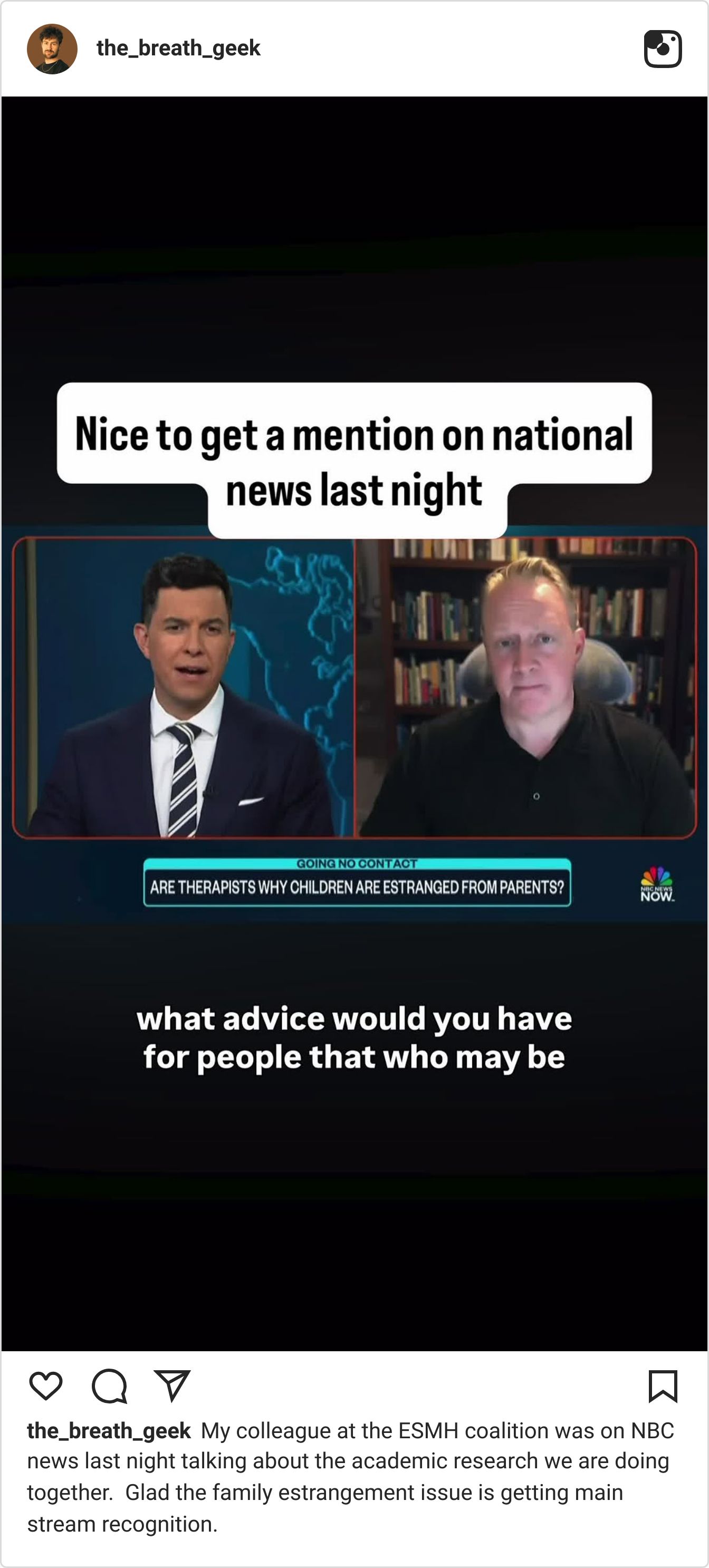
NBC ran a segment, too.
⏯️ Click here and fast forward to around 41 minutes to hear my part in it.
You can also watch it on my Instagram.
I could spend this email doing a victory lap. And to be clear, we did put a lot of work into this survey, so the coverage is great.
But I would rather tell you precisely what the numbers in our findings can and cannot carry. Because that’s why I think you’re here.
Let’s start with a correction in the article
Before I tell you what I think it means, the article needs a correction
The Journal described "some 7,000 estranged parents surveyed in April." In reality, there were two surveys, one of about 1,027 parents and one of about 4,226, collected across 2024 and 2025, roughly 5,253 people in total (Anderson and Blake, 2026). I do not know where 7,000 came from.
Even at the right count, the survey cannot prove what the coverage suggests.
We asked estranged parents what they believed happened between their therapists and their children. We asked them to guess what went on inside a room they were never in, often years after the fact. We wrote the context and limits into the OSF record ourselves, in plain language (Anderson and Blake, 2026).
Another thing to note: We recruited through channels that serve parents already looking for content on estrangement, which over-represents the parents who feel most wronged and under-represents the parents who started the cutoff or who carry real responsibility for it. For this survey in particular, we collected nothing from the adult children.
All of this to say, this is one side of the story, and it does not establish causation. Those are my words, sitting next to the data from the beginning.
If you read the headline of the WSJ piece as “"a third of estrangements are caused by therapists," I want you to know that, objectively, the survey does not show that.

What it does show, and why I still think it matters
Here is the interesting part: A large minority (31%) of parents blaming the therapist is itself a signal about how families now make sense of a rupture. Attribution is data.
Twenty years ago these parents would have named a partner, a religion or a move to another city. A meaningful share now name the therapist.
Here are two pieces of context the articles left out:
Prevalence. Karl Pillemer's nationally representative survey of 1,340 American adults found 27% currently estranged from a relative, with 10% estranged from a parent or a child (Pillemer, 2020). Estrangement is common. It was common before Instagram therapists existed.
Duration. Reczek, Stacey and Thomeer (2023) tracked 8,495 mother-child relationships and 8,119 father-child relationships in national longitudinal data. Most estrangements ended. 81% of adult children estranged from a mother later reconciled, as did 69% of those estranged from a father. Cutting contact is often a phase in a relationship rather than the end of one.
Here is where I will complicate my own side, because the alternative is dishonest: Any survey that asks only parents is hearing one voice in a two-voice room, and I would be a poor guide if I pretended otherwise.
And yet our respondents were less blameless than the stereotype predicts. Asked whether they had contributed to the conflict:
30% said yes in meaningful ways
Another 31% said possibly (Anderson and Blake, 2026).
That is 61% leaving the door open to their own part in it. I find that more honest than either the "toxic parent" caricature or the "blameless victim" one, and it is the reason I keep doing this work rather than picking a team. Thanks you for being here for these convesations {{ first_name | Reader }}.
Want to read the articles for yourself?
I’d love to hear your thoughts when you do. Here’s how you can read it if you don’t have a subscription:
Use this link to the WSJ article
Want to be one of the first in line for my book, launch events, and discussions?
Hold steady,
Richard
Smart starts here.

You don't have to read everything — just the right thing. 1440's daily newsletter distills the day's biggest stories from 100+ sources into one quick, 5-minute read. It's the fastest way to stay sharp, sound informed, and actually understand what's happening in the world. Join 4.5 million readers who start their day the smart way.

References
Anderson, P. and Blake, R. (2026) Parental Perspectives on Family Estrangement: Two Descriptive Surveys. Coalition for Ethical Standards in Mental Health. OSF. doi: 10.17605/OSF.IO/6XT53. Available at: https://osf.io/6xt53/overview
Bernstein, E. (2026) 'Are therapists to blame for the rise of adults cutting off their parents?', The Wall Street Journal, 21 July. Available at: [ADD WSJ URL] (subscription required).
NBC News (2026) [ADD SEGMENT TITLE AND BROADCAST DATE]. Available at: https://youtu.be/j0ucclsvG-A (survey discussed from around 41:00).
New York Post (2026) 'One-third of parents with estranged children blame therapy - as society becomes obsessed with "trauma"', New York Post, 21 July. Available at: https://nypost.com/2026/07/21/lifestyle/one-third-of-parents-with-estranged-children-blame-therapy-for-rift/ (free to read).
Pillemer, K. (2020) Fault Lines: Fractured Families and How to Mend Them. New York: Avery.
Reczek, R., Stacey, L. and Thomeer, M.B. (2023) 'Parent-adult child estrangement in the United States by gender, race/ethnicity and sexuality', Journal of Marriage and Family, 85(2), pp. 494-517. doi: 10.1111/jomf.12898.
Schoppe-Sullivan, S.J., Coleman, J., Wang, J. and Yan, J.J. (2021) 'Mothers' attributions for estrangement from their adult children', Couple and Family Psychology: Research and Practice, 12(3), pp. 146-154. doi: 10.1037/cfp0000198.